A Bag Making Machine that hot-cuts does two jobs with one tool: the heated blade melts through the film to separate the bag, and in the same stroke it fuses the cut edge closed. That single action is what makes the hot-cut format suited to vest bags, where an open, unsealed edge would fray or tear at the handle. You'll see how the dual-line layout works, where the servo and main motor split the load, and how the two model sizes differ.
Cold cutting uses a mechanical blade to sever the film without heat. That's suitable for materials that don't need a sealed edge, but on a plastic vest bag the cut edge stays open and can start a tear. Hot cutting uses a heated blade that cuts and seals at the same time. For a PE or PP carry bag that has to hold weight at the handle, the sealed cut edge is the difference between a bag that survives the checkout and one that fails in the parking lot.
The page lists production at 120–260 pcs/min × 2 lines. That's not a doubling of machine speed—it's two parallel webs running through the same sealing and cutting station. One machine cycle produces two bags, one from each lane, so the output per hour doubles without the heated blade and main drive working twice as fast. The trade-off sits in the film supply and the alignment: both lanes have to track consistently, or one lane's bags drift while the other stays in register.
The hot-cut blade is the component that defines the bag's edge quality. On a vest bag, the cut line runs along the handle opening and across the bottom of the bag. If the blade is at the right temperature and dwell, the film melts cleanly and the edge closes with a consistent bead. If the temperature is too low, the blade drags and the edge tears; too high, and the film shrinks back from the cut, leaving a thin, weak edge.
The page describes the dual-line format as producing double-sealed edges and stronger, tear-resistant handles through dual sealing technology. That's the mechanical advantage of running two lanes with the same sealing and cutting station: both bags receive the same blade temperature and the same dwell time, so the edge quality is consistent across lanes rather than varying from one side of the web to the other. Precision alignment keeps the two lanes synchronized, so the handle punch and the cut line land in the same relative position on both bags.
A vest bag carries load through the handle opening. The film around that opening is narrow, and any unsealed micro-edge becomes a stress concentration. Hot cutting closes that edge in the same motion that creates it, so the handle rim is sealed rather than raw. On a cold-cut machine, a separate sealing station would be needed to achieve the same result—which adds a step and slows the cycle.
The page lists a 1.5KW main power and a 2.4KW servo motor, with a 1.5KW inverter. Those aren't redundant numbers; they describe two different jobs.
The main motor drives the machine's primary mechanical cycle—the sealing and cutting motion. A 1.5KW main motor with a matching inverter is sized for the repetitive blade stroke and the film transport that happens in lockstep with it. The 2.4KW servo motor handles the positioning tasks: the film feed length, the registration of the printed mark if the film is printed, and the synchronization between the two lanes. Separating the drive duties means the main motor isn't asked to hold sub-millimeter positioning, and the servo isn't asked to deliver the peak torque of the cutting stroke.
| Parameter | RP-G450x2 | RP-G500x2 |
|---|---|---|
| Bag width | 200–400mm | 200–450mm |
| Bag length | 300–700mm (+1mm) | 300–700mm (+1mm) |
| Speed | 120–260 pcs/min × 2 | 120–260 pcs/min × 2 |
| Bag single thickness | 0.006–0.03mm | 0.006–0.03mm |
| Main power | 1.5KW | 1.5KW |
| Servo motor | 2.4KW | 2.4KW |
| Inverter | 1.5KW | 1.5KW |
| Weight | 3500KG | 4000KG |
| Dimension | 6500×2400×2000mm | 6500×2600×2000mm |
On a single-lane machine, a feed error shows up as one bag out of register. On a two-lane machine, the same error compounds: both lanes have to index the same distance at the same time, or the two bags end up with different handle positions. A 2.4KW servo with its own driver gives the feed axis enough torque and resolution to move both lanes together and hold the print-to-cut relationship across the web. That's why the servo rating is higher than the main motor rating on this model—the positioning load is the one that scales with lane count.
The page lists compatibility with PE, PP, and PVC, and a single-bag thickness range of 0.006mm to 0.03mm. That envelope covers the common carry-bag films: thin HDPE for economy bags, thicker LDPE for softness, PP for stiffness and clarity, and PVC for specialty applications.
The thickness range matters for the hot-cut blade setting. A 0.006mm film needs a lower blade temperature and a shorter dwell than a 0.03mm film, or the thin edge will shrink back and the thick edge won't fuse cleanly. The machine's temperature control and the servo-driven feed work together here—the servo sets the film position, and the blade temperature and dwell are set to match the gauge.
PE: the standard carry-bag film, running across the full 0.006–0.03mm range
PP: stiffer film for bags that need shape retention
PVC: specialty applications where the film's properties suit the end use
Two lanes: both webs run the same film gauge for consistent blade performance
The page notes quick specification switching for small-batch orders. In practice, that means changing the bag width and length through the servo and the lane guides, then adjusting the blade temperature for the film gauge. A two-lane machine makes this more involved than a single-lane setup because both lanes have to be re-referenced to the new bag position—but the servo-driven feed is what makes the change repeatable rather than a manual trial-and-error process.
The RP-G450x2 and RP-G500x2 differ mainly in bag width: 200–400mm on the 450, 200–450mm on the 500. That 50mm difference at the top end is the reason for the weight gap—3500KG versus 4000KG—and the slight difference in overall width, 2400mm versus 2600mm. The length and height are identical at 6500mm and 2000mm.
A 3.5–4 tonne machine with a 6.5-meter length is a floor-mounted production asset, not a benchtop unit. The page describes a modular design for simplified cleaning and maintenance, which matters on a machine of this size: the sealing and cutting station has to be accessible for blade changes and film threading without dismantling the whole frame.
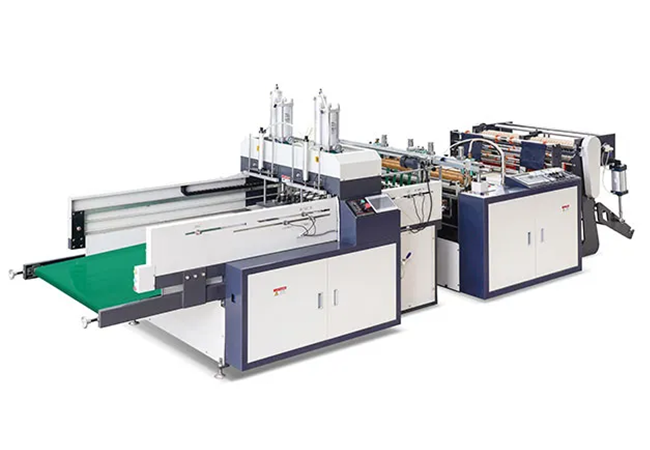
The Hot Cutting Plastic Bag Making Machine (2 Lines Vest Bags) from PLAST MACHINE is built around the dual-lane, hot-cut format the page describes: two parallel webs running through a shared sealing and cutting station, a 1.5KW main motor driving the blade cycle, a 2.4KW servo handling feed and registration, and a speed range of 120–260 pcs/min per lane across a 200–450mm bag width and 300–700mm bag length. The hot-cut blade closes the handle edge in the same stroke that separates the bag, so the finished vest bag comes off the machine with a sealed rim rather than a raw cut. For a producer running supermarket carry bags, retail vest bags, or promotional T-shirt bags, the Bag Making Machine value sits in the combination of the double-sealed handle and the two-lane output—the machine produces two finished bags per cycle, each with the same edge quality, rather than one bag per cycle at twice the blade speed.
Confirm the film type against the PE/PP/PVC compatibility list, the film gauge against the 0.006–0.03mm range, and the bag dimensions against the model's width and length envelope. The 2.4KW servo and 1.5KW main motor are sized as a pair—a film that requires unusually high blade temperature or a very long dwell may pull the practical running speed below the 260 pcs/min ceiling. A trial on the actual film is the step that confirms the hot-cut edge quality holds at your target rate.
Send over your bag width, length, film type, and target output—we'll help you check them against the RP-G450x2's 200–400mm width and 120–260 pcs/min per lane, or the RP-G500x2 if the format runs wider. Talk to PLAST MACHINE about your Bag Making Machine requirements and get a model-level answer before you commit to the line.
Nov 10,2026
Can a Bag Making Machine Run Two Lanes at Once?Nov 10,2026
How Does a Bag Making Machine Form Center Seal?
Environmentally friendly materials
Integrated production lines
Maximising your return on investment
GET A QUOTE


 English
 Español