A Plastic Pelletizing Machine in the two-stage configuration splits the recycling process into two distinct extrusion steps: the first stage melts and degasses the waste, and the second stage cools, reduces pressure, and pelletizes the melt at low speed. That separation is what allows the machine to process heavily printed film, wet bags, and mixed flakes into uniform pellets without the moisture and ink contamination that would degrade a single-stage output. This article explains why the two-stage architecture produces cleaner pellets, how the screw diameters and L/D ratios are matched, and what to verify when you're specifying a two-stage system for post-industrial or post-consumer waste.
A single-stage pelletizer melts the plastic and pushes it through a die in one continuous screw. That works for clean, dry, consistent scrap. But when the feedstock is heavily printed film, wet agricultural bags, or mixed-color flakes, the single screw has to do too many jobs at once: convey, melt, mix, vent moisture, and build pressure for the die. The result is often inconsistent melt quality, trapped gas, and pellets with visible contamination.
The two-stage design assigns those jobs to separate screws. The first stage handles the dirty work—melting, compacting, and venting the volatiles. The second stage receives a cleaner, more homogeneous melt and focuses on building the pressure and cooling profile needed for precise pellet formation. That division of labor is what makes the difference in pellet quality.
The connection point between the two extruders acts as an additional degassing zone. After the first stage melts and compacts the material, the melt passes through a venting section that removes moisture vapor and ink volatiles before the second stage. Some configurations also include a filtration step between stages to screen out solid contaminants.
That intermediate treatment is especially valuable for heavily printed films and post-consumer bags, where the ink layer and the absorbed moisture would otherwise create bubbles, voids, or surface defects in the finished pellet. The two-stage machine removes those volatiles while the melt is still in a controlled state, before the final pelletizing die.
The first-stage extruder receives the shredded or granulated waste and begins the melting process. The screw design compacts the low-bulk-density film or flake into a solid melt, expelling air and surface moisture through the venting section. The melt temperature is raised to the processing range, but the pressure is not yet built to the level needed for the die.
For heavily printed material, the first stage also begins to break down the ink layer. The heat and shear soften the ink, and the venting section carries the volatilized components away. The output from the first stage is a thick, uniform melt that’s ready for the second stage to finish the job.
The second-stage extruder is typically a smaller-diameter, longer-L/D screw that runs at a lower speed. Its job is not to melt the plastic further—the material is already melted—but to cool it slightly, reduce the pressure, and deliver a steady, homogeneous melt to the pelletizing die.
That low-speed operation is what gives the second stage its precision. A high-speed screw at the die would generate excess shear heat, and the pellet surface would degrade. The slow, controlled extrusion of the second stage produces a smoother pellet surface and a more consistent pellet size.
| Parameter | RP-C100 | RP-C110 | RP-C120 |
|---|---|---|---|
| Screw diameter (1st + 2nd) | 100mm + 90mm | 110mm + 100mm | 120mm + 110mm |
| Screw L/D ratio | 22:1 | 22:1 | 22:1 |
| Screw speed | 10–110 rpm | 10–110 rpm | 10–110 rpm |
| Main motor power | 22 kW | 30 kW | 37 kW |
| Max. extrusion output | 120 kg/h | 150 kg/h | 180 kg/h |
| Machine weight | 3,000 kg | 3,500 kg | 4,000 kg |
| Dimensions (L×W×H) | 8000×1350×1300 mm | 8200×1350×1300 mm | 8500×1350×1300 mm |
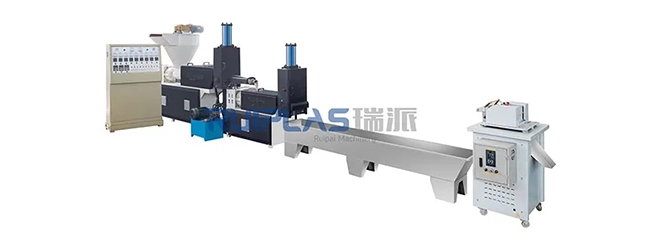
The first-stage screw is always larger than the second-stage screw. On the RP-C100, the first stage is 100mm and the second stage is 90mm. On the RP-C110, it’s 110mm + 100mm; on the RP-C120, 120mm + 110mm.
That diameter reduction is not arbitrary. The first stage has to convey and melt a low-bulk-density feedstock, so it needs a larger screw to handle the volume. The second stage receives an already-melted material, so it doesn’t need the same conveying capacity. A smaller second-stage screw provides better pressure control and a more precise melt delivery to the die.
The L/D ratio is 22:1 on both stages across all three models. That ratio is shorter than the 30:1 or 32:1 screws used in dedicated film blowing extruders, because the two-stage design distributes the melting and homogenizing work across two screws rather than requiring one long screw to do everything.
A Plastic Pelletizing Machine in the two-stage configuration is used to recycle plastic waste into reusable pellets or flakes for manufacturing new products. The system handles the waste streams that a single-stage pelletizer struggles with: heavily printed film, wet agricultural film, mixed-color bags, and post-consumer flakes with residual contamination.
The output range of 120–180 kg/h across the three models suits a small-to-mid-size recycling operation. For a converter that generates its own scrap and wants to reclaim it in-house, the RP-C100 provides the entry point. For a dedicated recycling facility handling a broader waste stream, the RP-C120 delivers the higher throughput.
The two-stage architecture also supports multiple plastic types, including PE, PP, and other thermoplastics, as long as the processing temperatures and screw configurations are matched to the material.
The output range is 120 kg/h on the RP-C100, 150 kg/h on the RP-C110, and 180 kg/h on the RP-C120. Match the model to your daily waste generation, not the peak. If your operation produces 1 ton of scrap per shift, the RP-C100 at 120 kg/h would need more than eight hours to process it. The RP-C120 at 180 kg/h would finish in under six hours, leaving capacity for growth.
The two-stage design handles heavily printed, water-content plastic films and bags more effectively than a single-stage machine because of the intermediate degassing. But the system is not a washing line. If the waste contains sand, metal, or heavy solid contamination, a pre-washing and filtration step is still required before the pelletizer.
Check the venting section between the stages for blockage from ink residue or degraded material. A blocked vent reduces the degassing efficiency and the pellet quality drops. Inspect the second-stage screw for wear—because it runs at low speed, the wear is slower than the first stage, but the die-face cutting unit still needs regular blade inspection. Verify the heater bands on both barrels for even temperature distribution, and clean the filtration screen if the configuration includes one.
A one-stage machine melts and pelletizes in a single screw. A two-stage machine melts in the first screw, then transfers the melt to a second screw for cooling, pressure reduction, and final pelletizing. The two-stage design handles dirtier, wetter, and more heavily printed feedstock because the intermediate degassing removes volatiles before the die.
The intermediate venting section removes a significant amount of surface moisture and volatiles, so the machine can handle wet film better than a single-stage design. But extremely wet material may still need mechanical dewatering before feeding. The venting capacity is not a substitute for a dryer when the moisture content is very high.
The first stage must convey and melt low-bulk-density waste, so it needs a larger diameter. The second stage receives an already-melted material and focuses on pressure control and pellet quality, so a smaller screw provides better precision. The diameter reduction also helps reduce the pressure from the first stage to a level suitable for the die.
The pellet size is set by the die hole diameter and the cutting speed. The die-face cutter runs against the die plate, and the pellet length is controlled by the feed rate relative to the cutter speed. The two-stage machine’s consistent melt pressure from the second stage is what allows the pellet size to stay uniform across the production run.
A Plastic Pelletizing Machine in the two-stage configuration should match your feedstock type, contamination level, and daily output—not the other way around. The Two Stages Plastic Recycling Machine from Ruipai offers 100+90mm, 110+100mm, and 120+110mm screw combinations across the RP-C100, RP-C110, and RP-C120 models, with outputs from 120 kg/h to 180 kg/h and 22:1 L/D ratios on both stages. If you’re recycling heavily printed film, wet bags, or mixed flakes into reusable pellets, send us your material, contamination level, and output target — we’ll help you confirm the right model before you order.
Nov 03,2026
How Does a Bag Making Machine Form Center Seal?
Environmentally friendly materials
Integrated production lines
Maximising your return on investment
GET A QUOTE


 English
 Español