A Bag Making Machine in the center-sealing configuration takes a single flat roll of laminated film, folds it centrally into a tube, and seals the overlapping edges at the back of the pouch. That single-web fold is what separates a center-seal machine from a three-side-seal or four-side-seal line, which needs two separate film webs. This article explains how the folding and sealing stations work together, what the dual-servo drive contributes to print registration, and what to verify when you're matching a center-seal line to your pouch production.
The process starts at the unwind station. A single roll of laminated film is mounted on the unwind shaft, and the web is fed through a folding plow that brings both edges toward the centerline. The film is formed into a tube with the edges overlapping at the back. The longitudinal sealer then bonds that overlap, creating the center seam that gives the pouch its name.
Once the tube is sealed, the bottom sealer closes one end, the pouch is filled (in an inline filling configuration), and the top sealer closes the other end before the cross-cut blade separates the finished pouch. The entire sequence runs on one continuous web, which means there is no second roll to align and no second web to synchronize. That single-web architecture is what allows the center-seal machine to run at high speed with less film waste than a multi-web line.
The center seam is a longitudinal seal that runs the full length of the pouch. If the sealing temperature drifts, the seam strength varies from pouch to pouch. A cold seal delaminates; an overheated seal burns through the film or distorts the print.
The sealing station uses PID intelligent temperature control that holds the blade temperature within ±1°C even at full production speed. That tight window matters on laminated films with a thin PE sealant layer, where the difference between a good bond and a burn-through is only a few degrees. The PID loop compensates for the heat drawn away by the moving film, so the first pouch and the thousandth pouch see the same sealing condition.
| Parameter | Typical Center-Seal Specification |
|---|---|
| Bag type output | Back seal, fin seal, lap seal, pillow pouch |
| Drive system | Dual servo (feed + seal cycle) |
| Film compatibility | PET/PE, BOPP/PE, NY/PE, aluminum laminate, Kraft/PE |
| Film thickness | 0.04–0.15 mm |
| Max bag width | 350 mm (330 mm effective seal width) |
| Bag length range | 50–300 mm (skip-seal extends to 9× pitch) |
| Production speed | 80–120 bags/min (material and size dependent) |
| Temperature control | PID, stable to ±1°C at full speed |
| Power supply | 380V / 50Hz / 3-phase, ~7.5kW |
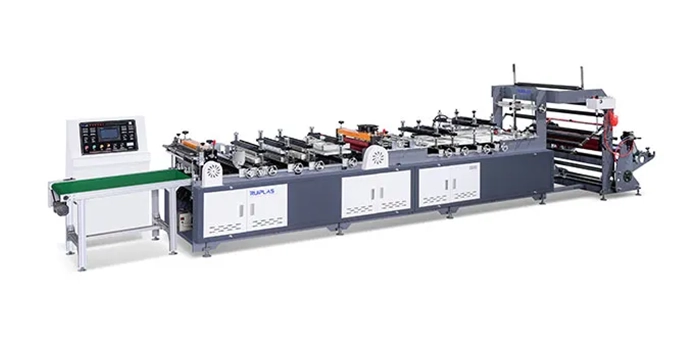
A single-servo machine ties the film feed and the sealing cycle to one motor. When the machine accelerates or decelerates, the sealing dwell time changes with the speed, and the print registration drifts. A dual-servo machine uses one servo for the film feed and a second servo for the sealing cycle, so the seal time stays constant even as the cut speed varies.
That separation is what allows a center-seal machine to hold print registration on pre-printed laminates at production speed. The feed servo controls the draw length and the print position, while the seal servo controls the dwell time. The two axes are synchronized electronically, so the seal lands in the same position relative to the printed design on every cycle.
The unwind station uses dual photocell tracking with edge correction to keep the web centered as it enters the folding plow. If the web wanders laterally, the center seam shifts off the back centerline, and the pouch is rejected downstream. The dual photocell arrangement reads both edges of the web and corrects the unwind position continuously, so the folding plow always receives the web at the same lateral position.
A center-seal machine is built for heat-sealable laminated films. The common structures include PET/PE, BOPP/PE, NY/PE, aluminum laminate, Kraft/PE, and CPP/BOPP. Each structure serves a different barrier requirement:
PET/PE — the standard food packaging laminate, with a print-ready PET outer layer and a PE sealant inner layer.
BOPP/PE — high clarity and stiffness, used for transparent-window pouches.
Aluminum laminate — maximum moisture, oxygen, and light barrier for extended shelf life.
NY/PE — puncture resistance and oxygen barrier for sharp-edged contents.
Kraft/PE — a paper-forward structure for eco-positioned brands.
The film thickness range is typically 0.04–0.15 mm. Thinner films in the 0.04–0.06 mm range run at the higher end of the speed window; thicker multi-layer foils run slower to allow the seal zone to reach temperature.
A Bag Making Machine with center-seal capability produces the pouch formats used in food, pet food, commodities, fertilizer, and seeds. The back-seal format is the standard for coffee and food pouches globally, while the lap-seal format produces a flatter seam that is preferred for cosmetics and premium retail.
The center-seal pouch is also the base structure for a stand-up pouch with a zipper when the machine is equipped with a bottom gusset forming unit. The single-web architecture makes the stand-up pouch production economical, because there is no second web to align and no film loss from a separate bottom sheet.
Check the maximum bag width against your widest pouch. A typical center-seal machine handles up to 350 mm bag width, with an effective seal width of around 330 mm. If your product needs a wider pouch, confirm whether the machine has a wider model or a custom configuration.
Confirm the machine's film thickness range against your laminate structure. The typical window is 0.04–0.15 mm. A machine that is set up for thin sachet film may not have the sealing dwell time for a thick aluminum laminate. Test your actual film on the machine before committing to a production order.
Many center-seal machines are configured with zipper closure, euro slot, tear notch, and custom die-punch options. Confirm the attachment set against your pouch design. A machine that lacks the zipper module cannot be upgraded without a hardware change.
Inspect the longitudinal sealing blade for coating wear or polymer buildup. A contaminated blade transfers uneven heat and produces a weak center seam. Check the PID temperature reading against a calibrated reference and verify that the ±1°C control is holding across the full speed range. Clean the photocell lenses on the edge correction system to maintain web tracking.
A center-seal pouch is formed from a single web folded into a tube, with the seam at the back. A three-side-seal pouch is formed from two separate webs, with seals on the two sides and the bottom. The center-seal structure uses less film and produces a stronger back seam, which is why it is the standard for coffee and heavy-duty food pouches.
Yes. A machine equipped with the lap-seal configuration overlaps the film edges before sealing, producing a thinner, flatter longitudinal seam than the back-seal format. The changeover between back-seal and lap-seal is a fold-guide adjustment, not a mechanical rebuild.
The cooling station presses the sealed area against a cooled bar to set the seal before the pouch is cut or filled. Without cooling, the sealant layer remains soft, and the cross-cut blade can drag the seal apart. The cooling station is what allows the machine to run at high speed without sacrificing seal integrity.
Center-seam drift usually comes from web tracking error at the unwind or a misaligned folding plow. Check the dual photocell edge correction system first—dust on the lens or a misadjusted sensor causes the web to wander. If the tracking is correct, verify that the folding plow is centered and the film is entering the plow at the correct angle.
A Bag Making Machine in the center-seal configuration should match your film structure, bag width, and production speed—not the other way around. A typical center-seal platform runs 80–120 bags/min on PET/PE, BOPP/PE, NY/PE, aluminum laminate, and Kraft/PE films from 0.04–0.15 mm thick, with dual-servo feed and seal control, PID temperature stability at ±1°C, and a maximum bag width around 350 mm. If you're specifying a center-seal line for food, pet food, or commodity pouches, send us your film structure and bag dimensions — we'll help you confirm the right configuration before you order.
Oct 27,2026
How Does a Bag Making Machine Form Center Seal?
Environmentally friendly materials
Integrated production lines
Maximising your return on investment
GET A QUOTE


 English
 Español