A jumbo roll arrives at your plant — 1,300mm wide, hundreds of meters long. Your customer needs 200mm strips, twenty of them, wound tight with clean edges on both sides. A Slitting Machine in the horizontal configuration does that job by unwinding the parent roll, guiding the web through a set of circular blades, and rewinding the narrow strips onto separate cores. This article explains how each section of the machine works, what keeps the cut edges straight, and what to verify when you're matching a slitter to your converting operation.
The unwinding section holds the parent roll and feeds material into the cutting zone. The roll sits on a shaft or a shaftless chuck, depending on the machine design. As the roll diameter shrinks from full to empty, the surface speed changes if the rotational speed stays constant. The tension control system compensates by adjusting the unwind brake torque, so the web enters the cutting section at a consistent tension regardless of how much material remains on the roll.
Tension matters because it determines how the web behaves as it passes through the blades. Too little tension and the web wanders laterally, causing the cut lines to drift. Too much tension and the web stretches, which changes the slit width and can cause the material to snap. The RUIPAI horizontal slitting machine handles rolls up to 600mm in diameter and 700mm, 1100mm, or 1300mm in width depending on the model, with tension maintained as the roll unwinds.
A horizontal slitter feeds the web along a flat path, with the material traveling from the unwind stand to the slitting section and then to the rewind station in a straight line. That horizontal layout gives the web full support across its width as it moves, which matters for heavier materials — thick films, paper board, and laminates that would sag if fed vertically.
Horizontal slitters are better suited for thicker, heavier materials that require more robust cutting power, while vertical machines excel at high-speed, precise cutting of lighter materials. The horizontal configuration also makes the slitting section more accessible for blade changes and web threading.
Web alignment is the hardest part of slitting. If the web drifts a millimeter to the left as it enters the blades, the slit width changes by a millimeter on every strip. Over a production run of thousands of meters, that drift compounds into a quality problem.
The RUIPAI horizontal slitting machine uses a deviation rectifying system with ±0.5mm error tolerance. An edge sensor detects the web's position and sends a signal to a guide roller that shifts the web laterally to compensate. The correction happens continuously as the web moves, so the slitting position stays locked to the web edge rather than to the machine frame. That distinction matters because the parent roll itself may have a slightly uneven edge — the guide system follows that edge so the slit widths stay true to the original material.
The cutting section uses circular slitting blades mounted on upper and lower shafts. The blades shear the web as it passes between them, creating a clean cut without the dust and deformation that crush cutting produces. The blade spacing determines the slit width, and the spacing can be adjusted to produce strips from 30mm to 600mm on the RPQ-700 model, up to 1,200mm on the RPQ-1300.
Blade sharpness and overlap are the two variables that affect cut quality. A dull blade tears the material instead of shearing it, leaving a ragged edge. Insufficient blade overlap produces an incomplete cut that can cause the web to break at the slitting station. The machine's blade holders are designed for precise adjustment, so the operator can set the overlap to suit the material thickness.
| Model | RPQ-700 | RPQ-1100 | RPQ-1300 |
|---|---|---|---|
| Max. width of mother roll | 700mm | 1100mm | 1300mm |
| Max. diameter of mother roll | 600mm | 600mm | 600mm |
| Cutting width range | 30-600mm | 30-1000mm | 30-1200mm |
| Slitting speed | 5-200m/min | 5-200m/min | 5-200m/min |
| Deviation rectifying error | ±0.5mm | ±0.5mm | ±0.5mm |
| Total power | 2.7kW | 3.5kW | 3.5kW |
| Machine weight | 1,200kg | 1,500kg | 1,800kg |
| Dimensions | 2000×1110×1400mm | 2300×1110×1400mm | 2600×1110×1400mm |
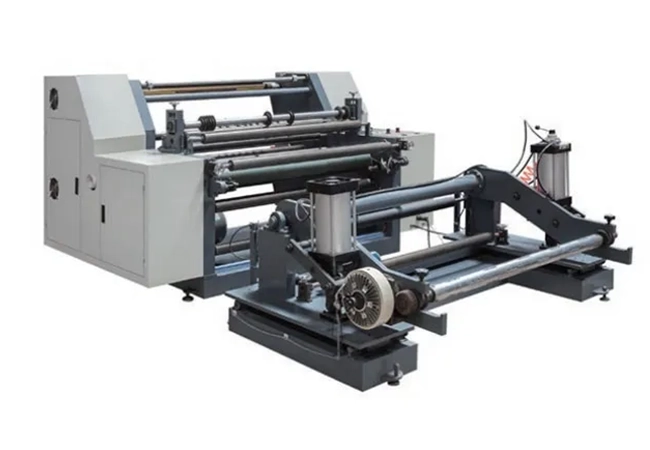
The rewinding section takes the narrow strips coming out of the cutting zone and winds each one onto its own core. A slitter may have two, three, or more rewind stations depending on the number of strips the customer needs. Each station has its own tension control so that the strips wind at consistent hardness.
Rewind tension is just as important as unwind tension. If a strip winds too loosely, the roll telescopes during handling and the edges get damaged. If it winds too tightly, the material stretches and the roll may deform. The rewind station's tension control system adjusts as the rewinding diameter grows, maintaining the same winding density from core to full roll.
The slitting speed ranges from 5 to 200 meters per minute across all three RUIPAI models. At 200m/min, the machine is moving material through the blades at more than 3 meters per second. The unwind, cutting, and rewind sections have to stay synchronized at that speed — if the rewind pulls faster than the unwind feeds, the web tension spikes; if the unwind feeds faster than the rewind collects, the web goes slack and wanders. The drive system coordinates all three sections through a single control loop, keeping the web tension stable across the full speed range.
Horizontal slitting machines handle a broad range of roll materials. The RUIPAI slitter processes plastic film, paper, aluminum foil, nonwoven fabric, and other roll materials. That range covers the majority of flexible converting applications:
Plastic film converters — slitting BOPP, PET, PE, and CPP film for packaging, labeling, and lamination
Paper mills and converters — reducing jumbo paper rolls into customer-width strips for printing and packaging
Aluminum foil processors — cutting foil for food packaging, insulation, and industrial use
Nonwoven producers — slitting hygiene, medical, and industrial nonwoven rolls into usable widths
The 5-200m/min speed range and ±0.5mm deviation correction make the machine suitable for both high-volume commodity slitting and precision work where strip width tolerances are tight.
The equipment can be customized to meet production requirements for cutting width, with simple adjustments that allow it to quickly adapt to different cutting needs. That flexibility means a converter running multiple product lines doesn't need a separate slitter for each strip width — the blade spacing changes, the rewind stations are repositioned, and the same machine runs the next job.
Match the machine's maximum mother roll width to your widest incoming roll. The RPQ-700 handles 700mm rolls, the RPQ-1100 handles 1,100mm, and the RPQ-1300 handles 1,300mm. Buying a machine wider than you need adds cost and floor space without adding capability.
Check the strip width range against your narrowest and widest cuts. All three models cover 30mm as the minimum, but the maximum varies: 600mm on the RPQ-700, 1,000mm on the RPQ-1100, and 1,200mm on the RPQ-1300. If your narrowest strip is under 30mm, you'll need a different blade configuration.
Material thickness affects blade selection and cutting speed. Thicker materials require more blade overlap and may run at the lower end of the speed range. Thinner films run faster but are more sensitive to tension variations. Test the material on the machine before committing to a full production run.
Start with the material supplier's recommendation, then adjust based on how the web behaves. A film that wrinkles as it enters the blades is running too loose — increase unwind tension. A film that narrows as it passes through the blades is running too tight — decrease tension. The goal is a web that stays flat and centered without stretching. The RUIPAI machine's tension control system lets operators adjust settings as they watch the web run.
Ragged edges usually come from dull blades or incorrect blade overlap. A blade that's been running for too long develops a rounded edge that tears rather than shears. Insufficient overlap causes the material to pull apart instead of cutting cleanly. Check the blade condition and overlap setting first. If the blades are sharp and the overlap is correct, check the web tension — a loose web can wander into the blade at an angle, which produces a rough cut even with a sharp blade.
Yes, within the blade spacing range. The operator positions the circular blades at the desired intervals along the blade shafts, then sets the rewind stations to match the strip positions. Changeover time depends on how many strips you're running and how much the spacing changes. A job that goes from twenty narrow strips to five wide strips takes longer to set up than one that shifts every strip by a few millimeters.
Check blade sharpness regularly and replace or resharpen blades when the cut quality drops. Clean the web guide sensors — dust or material buildup on the sensor lens causes the deviation correction system to misread the edge position. Inspect the rewind cores and chucks for wear, and check the tension control belts or couplings for slippage. Lubricate the guide rollers and blade shafts according to the manufacturer's schedule.
A Slitting Machine should match your incoming roll dimensions, target strip widths, and material type — not the other way around. The Horizontal Slitting Machine from RUIPAI comes in three models covering 700mm, 1,100mm, and 1,300mm maximum mother roll widths, cuts strips from 30mm to 1,200mm, and runs at 5-200m/min with ±0.5mm deviation correction. It handles plastic film, paper, aluminum foil, and nonwoven fabric, with customizable cutting widths for different production runs. If you're specifying a slitter for film, paper, foil, or nonwoven converting, send us your roll width and strip requirements — we'll help you confirm the right model before you order.
Environmentally friendly materials
Integrated production lines
Maximising your return on investment
GET A QUOTE


 English
 Español