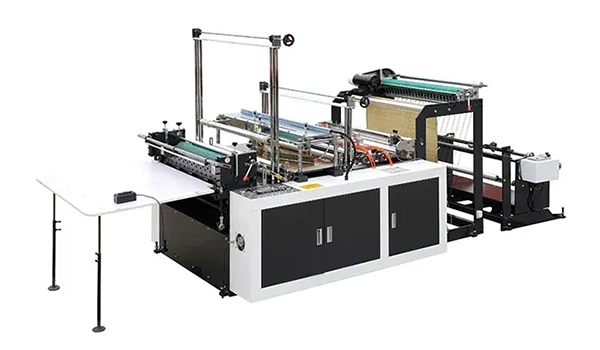
You've seen the clear plastic cover that protects a new suit or dress on the rack at a clothing store. That cover didn't come pre-made from a supplier — it was formed, sealed, and punched on a Bag Making Machine designed specifically for garment bags. The machine takes a roll of PE, PP, or PVC film, forms it into a bag, punches a hanger hole at the top, and seals the edges in one continuous pass. The RP-FQ series from Ruipai Machinery runs this process at 30-130 pieces per minute across four width options. This article explains how the seal forms, how the hanger hole gets punched, and how to match the machine to your apparel packaging line.
A garment bag starts as a flat roll of plastic film. The film unwinds and feeds through a series of rollers that control tension and alignment. The machine then seals the side edges, cuts the bag to length, and punches a hanger hole near the top. The result is a clear, flat bag with an opening at the bottom for sliding a garment inside.
The hanger hole is the feature that separates a garment bag from a general-purpose poly bag. The hole has to be clean and centered so the hanger hook passes through without tearing the film. The RP-FQ series punches this hole automatically as part of the production cycle, so you're not running a separate punching operation downstream.
Bag making speed depends on the width you're running. The RP-FQ600 handles bags up to 550mm wide at 30-130 pcs/min. As bag width increases, speed drops: the RP-FQ1200 runs up to 1150mm wide at 30-100 pcs/min. The trade-off is simple physics — wider bags need more film per cycle, and the sealing and cutting mechanisms need more time to complete each motion.
The sealing mechanism bonds the film layers together using heat and pressure. The cut follows immediately after, separating the finished bag from the film web. Because the seal and cut happen in the same machine cycle, the bag length stays consistent across the run. The maximum bag length on all RP-FQ models is 1600mm, which covers everything from shirt covers to long dress and coat bags.
Film tension matters here. If the film feeds unevenly, the seal can drift off the cut line, leaving a bag with a crooked edge or a weak seal. The machine's roller system keeps tension steady, and the modular design makes it easy to access the sealing and cutting stations for cleaning and maintenance.
The RP-FQ series handles PE, PP, PVC, and other plastic films, with customization available for specific raw materials. Each material gives the finished garment bag a different feel and clarity:
PE film — soft, flexible, and economical; the standard choice for high-volume retail and laundry covers
PP film — stiffer and clearer than PE, with better stiffness for hanging garments that need structure
PVC film — the clearest of the three, with a glass-like transparency for premium apparel presentation
The film you pick affects more than appearance. It changes how the bag hangs on a rack, how it feels in a customer's hand, and how it performs through shipping and handling. PP and PVC bags hold their shape better on a hanger, while PE bags conform more tightly to the garment.
| Model | RP-FQ600 | RP-FQ800 | RP-FQ1000 | RP-FQ1200 |
|---|---|---|---|---|
| Max. bag making width | 550mm | 750mm | 950mm | 1150mm |
| Max. bag making length | 1600mm | 1600mm | 1600mm | 1600mm |
| Bag making speed | 30-130 pcs/min | 30-130 pcs/min | 30-120 pcs/min | 30-100 pcs/min |
| Main power | 1.1KW | 1.5KW | 2.2KW | 3.0KW |
| Weight | 700KG | 800KG | 900KG | 1000KG |
Garment bags show up wherever clothing needs protection without hiding the product. That covers a wide range of settings:
Retail clothing stores — hanging covers for suits, dresses, and jackets on the sales floor
Dry cleaning and laundry — protective covers that keep cleaned garments dust-free during transport
E-commerce fulfillment — lightweight bags that protect garments during shipping without adding bulk
Uniform suppliers — covers for bulk uniform orders before distribution
Fashion showrooms — presentation bags that keep samples clean and wrinkle-free
A Bag Making Machine like the RP-FQ series from Ruipai Machinery fits into these operations because it produces bags on demand rather than requiring you to order pre-made covers in bulk. The machine's modular design and accurate dosing system minimize film waste, and the ability to switch production specifications quickly makes it practical for shops that run multiple bag sizes in short batches.
Bag width should match the widest part of the garment, not the hanger. A suit jacket measured shoulder-to-shoulder needs a bag wide enough to slide over the shoulders without stretching the film. If the bag is too narrow, the garment bunches at the shoulders and the hanger hole tears under the weight.
The RP-FQ series covers a wide range of garment sizes. The RP-FQ600 handles 550mm wide bags for shirts, blouses, and children's clothing. The RP-FQ800 at 750mm covers suits and jackets. The RP-FQ1000 and RP-FQ1200 handle 950mm and 1150mm bags for coats, gowns, and oversized garments.
Bag length matters too. The 1600mm maximum length covers long dresses and coats, but you don't have to run at maximum length for shorter garments. The machine cuts to the length you set, so a shirt bag and a coat bag can come off the same machine on different runs.
For operations that run multiple garment types, the ability to switch bag width and length between runs is as important as the production speed. The RP-FQ series supports quick specification changes, which keeps changeover time short when you're moving from shirts to suits to coats.
Yes, with the right model. The RP-FQ series offers four width options — 550mm, 750mm, 950mm, and 1150mm — each covering a range of bag sizes. Within a model's width range, you can adjust bag length on the same machine. If your operation regularly runs both shirt bags and coat bags, pick a wider model that covers both rather than buying two narrow machines.
Thinner film gives you a softer, more flexible bag that conforms to the garment. Thicker film gives you a stiffer bag that holds its shape on the hanger. For retail display, a mid-range thickness balances clarity and durability. For laundry and transport covers where the bag takes more handling, a slightly thicker film reduces the chance of tearing at the hanger hole. Test a few thicknesses on your actual garments before committing to a large film order.
The hole tears when the film is too thin for the garment's weight or when the punch isn't clean. A dull punch leaves a rough edge that starts a tear. Make sure the punch stays sharp and the film tension is consistent. If you're covering heavy garments like wool coats, step up to a thicker film or a PP film that resists tearing better than PE.
The modular design makes cleaning and maintenance straightforward. Clean the sealing and cutting stations regularly to prevent film residue from building up. Check the punch for wear and replace it when the hole edge starts looking ragged. Lubricate moving parts according to the manufacturer's schedule, and inspect the film path for any buildup that could affect tension.
A Bag Making Machine for garment bags should match your garment sizes, film material, and production volume — not the other way around. The RP-FQ series from Ruipai Machinery runs 30-130 pcs/min, handles bags up to 1600mm long and 1150mm wide, and produces clear covers with automatic hanger holes on PE, PP, and PVC film. If you're setting up or expanding an apparel packaging line, send us your garment dimensions and film requirements — we'll help you confirm the right model and configuration before you order.
Environmentally friendly materials
Integrated production lines
Maximising your return on investment
GET A QUOTE


 English
 Español