You're slitting film rolls for packaging or label production, and the cuts need to stay clean from the first meter to the last. A Slitting Machine that controls tension properly keeps the web flat, prevents edge wandering, and produces rolls that unwind without blocking. The Vertical Slitting Machine from Plast Machine uses a vertical film path, a dancer roller, and automatic tension control to hold the web steady through the slitting station. This article explains how tension control affects cut quality, what the vertical layout delivers for floor space and access, and what to verify before specifying a slitting system for your film rolls.
Tension is the force that holds the film flat as it travels from the unwind roll to the slitting blades. If tension is too low, the film wrinkles, the slit edges wander, and the finished rolls look loose. If tension is too high, the film stretches, the slit width drifts, and thin films can tear. The vertical slitting machine uses a dancer roller to sense tension and a magnetic powder brake to adjust it automatically. As the unwind roll diameter shrinks, the brake torque decreases to maintain the same web tension. This keeps the slit width consistent and the finished rolls firm.
The dancer roller moves in response to tension changes, sending a signal to the brake controller. The magnetic powder brake adjusts torque without mechanical wear, maintaining consistent tension from the start of the roll to the end.
When tension drifts, the slit edges become wavy or the film stretches. The finished rolls may have soft spots, causing blocking or telescoping during unwinding. Automatic tension control prevents these defects.
The vertical film path arranges the unwind roll, slitting station, and rewind rolls in a vertical line. This layout saves floor space compared to a horizontal machine, and it provides easy access to the slitting blades and guide rollers. The operator can thread the film and change blades without reaching over a long horizontal web. The vertical path also lets gravity assist in keeping the film flat, reducing the chance of wrinkles before the slitting station.
A vertical layout uses height instead of length. For converters working in narrow bays or shared production halls, this can be the difference between fitting the machine and not fitting it.
The slitting blades sit at a comfortable working height on a vertical machine. Blade changes and edge alignment checks take less time, reducing downtime between jobs.
| Parameter | Specification |
|---|---|
| Model | Vertical Slitting Machine |
| Max. Unwind Diameter | Φ800mm |
| Max. Rewind Diameter | Φ600mm |
| Slitting Speed | 10-120 m/min |
| Slit Width Range | 30-600mm |
| Max. Web Width | 1300mm |
| Suitable Materials | BOPP, PET, PE, CPP, paper, laminates |
| Tension Control | Automatic dancer roller + magnetic powder brake |
| Edge Guiding | Photoelectric web guide |
| Slitting Method | Razor blade or circular knife |
| Power Supply | 380V, 3-phase, 50Hz |
| Total Power | ~8kW |
| Machine Dimensions | ~1800×1200×1600mm |
The 10-120 m/min speed range allows operators to match production speed to material thickness and slit width. The 30-600mm slit width range covers common flexible packaging formats.
The machine handles BOPP, PET, PE, CPP, paper, and laminates. This range covers food packaging, label stock, and industrial film applications.
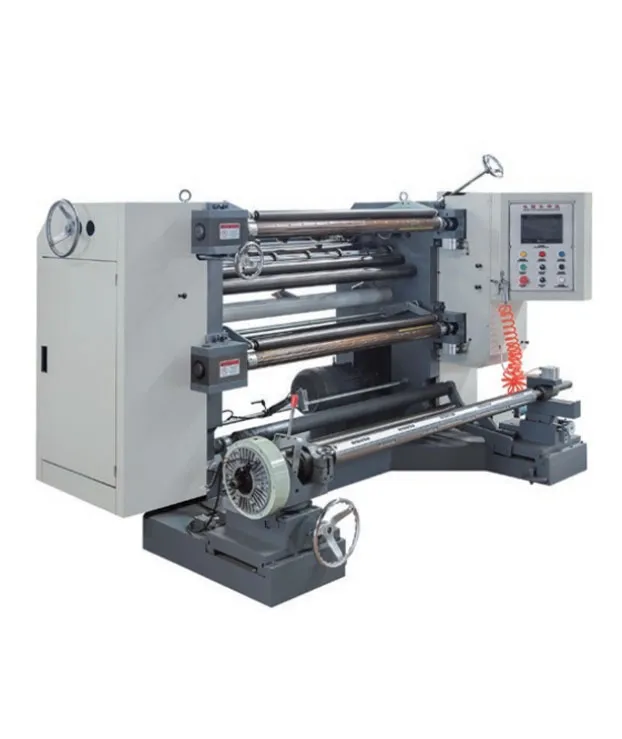
A vertical slitter fits where floor space is limited and film rolls must be converted into narrower widths. Flexible packaging converters, label printers, and film distributors all use slitting to turn jumbo rolls into finished rolls.
Flexible packaging — slitting BOPP, PET, and PE rolls for bag making
Label production — converting label stock into finished roll widths
Film distribution — producing customer-specific roll widths from master rolls
Lamination lines — slitting laminated film after coating or bonding
Industrial films — slitting protective and specialty films
Bag makers need rolls in specific widths. The vertical slitter produces clean-edged rolls that feed smoothly into bag-making machines.
Label printers and laminators use slitting to match roll width to press requirements. The photoelectric web guide keeps the slit position accurate.
A vertical slitter arranges the film path from top to bottom, saving floor space and improving blade access. A horizontal slitter arranges the path from side to side, which may suit wider webs or specific line layouts.
The tension control system adjusts brake torque to match film thickness. Thinner films require lower tension; thicker films require higher tension. The dancer roller senses the requirement automatically.
Routine maintenance includes checking blade sharpness, cleaning the photoelectric web guide sensor, verifying dancer roller movement, and inspecting the magnetic powder brake for consistent torque. Worn blades should be replaced promptly to avoid edge defects.
Yes. The slit width range is 30-600mm, and the machine can be configured for different rewind roll counts and core sizes based on customer requirements.
A Slitting Machine with vertical film path, automatic tension control, and 10-120 m/min speed is the practical choice for converters who need clean film rolls in limited floor space. The Vertical Slitting Machine from Plast Machine delivers Φ800mm max unwind diameter, Φ600mm max rewind diameter, 30-600mm slit width range, photoelectric web guiding, and BOPP/PET/PE/CPP material compatibility.
Whether you're slitting film for bag making, labels, or industrial applications, this Slitting Machine offers the tension control and edge accuracy that downstream processes require. With a compact vertical layout and easy blade access, it keeps production running with minimal downtime.
Contact Plast Machine for a vertical slitting configuration assessment → their team can help you select the right slit width, rewind configuration, and tension settings for your specific film rolls and production targets. Get a Slitting Machine that keeps the web flat and the edges clean — so every roll feeds smoothly into the next process.
Environmentally friendly materials
Integrated production lines
Maximising your return on investment
GET A QUOTE


 English
 Español