You're running a plastic bag production line. The orders keep coming — T-shirt bags for supermarkets, vest bags for retail, promotional bags for events. Your current single-line machine is maxed out. Adding another machine means more floor space, more operators, and more capital. There has to be a smarter way to increase output.
A bag making machine with double-line hot cutting technology is that smarter way. Instead of running one lane of bags, you run two — simultaneously, on the same machine, with the same operator. The hot cutting process seals and cuts in one step, producing stronger bags at higher speeds. This guide covers what a hot cutting double-line bag making machine does, how it delivers double the output, and what to look for when choosing one for your operation.
The numbers tell the story. Two lanes running simultaneously mean twice the bags per minute without twice the footprint.
A double-line hot cutting bag making machine runs two lanes in parallel, each producing 120-200 bags per minute, for a total of 240-400 bags per minute. That's not peak speed that drops as the day goes on — it's sustained output across a full shift. For a bag manufacturer running high-volume orders — supermarkets, retail chains, promotional campaigns — that throughput translates directly to on-time deliveries and satisfied customers.
Running two separate single-line machines requires two operators, twice the floor space, and twice the maintenance. A double-line machine runs two lanes with one operator. The labor cost per bag drops significantly. For production managers, that means higher output without hiring more people.
A double-line machine takes up roughly the same footprint as a single-line machine but produces twice the output. For bag manufacturers with limited floor space, that's the difference between scaling up and staying put.
The cutting method determines bag quality and production speed. Hot cutting offers advantages that cold cutting can't match.
Hot cutting uses controlled heat to cut and seal the plastic film simultaneously. Instead of sealing first and cutting second, the machine does both in a single operation. The result is faster cycle times and stronger edges that don't fray or leak.
The heat-sealed edge is stronger than a cold-cut edge. For T-shirt bags that carry weight — groceries, merchandise, retail items — that edge strength means fewer bag failures and happier customers. The clean heat seal also reduces the risk of material fraying or leakage.
Hot cutting is the standard for T-shirt bags (also called vest-type carry bags). The process produces bags with two parallel heat-sealed edges and a clean-cut handle section. For supermarkets and retail, this is the bag type that customers expect — strong, reliable, and consistent.
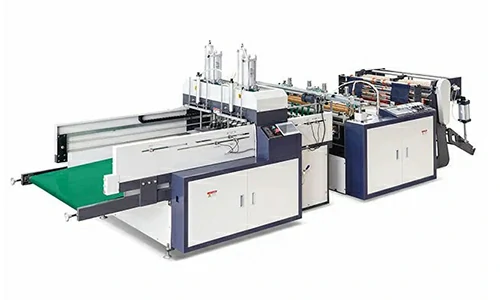
The double-line hot cutting bag making machine handles the materials and bag types that drive the retail packaging market.
The machine processes HDPE and LDPE roll film. These are the standard materials for T-shirt bags, grocery bags, and merchandise bags. For bag manufacturers running these materials daily, the machine is a direct fit.
The machine is specifically designed for T-shirt bags (vest-type carry bags). These are the bags with die-cut handles and a gusseted bottom — the standard for supermarket checkout counters, retail stores, and promotional giveaways. The double-line configuration is ideal for high-volume production of these bag types.
Supermarkets and retail chains order T-shirt bags by the pallet. A double-line machine produces the volume needed to fill these orders quickly. For bag manufacturers supplying retail customers, the combination of speed and consistency is essential.
Q: Hot cut vs. cold cut — what's the difference?
A: Hot cutting uses heat to cut and seal the plastic film simultaneously, creating a sealed edge. Cold cutting cuts the film without sealing it, which means the edges remain open. Hot cutting produces stronger edges and is standard for T-shirt bags and vest bags. Cold cutting is typically used for bags that don't require sealed edges, like flat bags or open-top bags.
Q: What film can it run?
A: The machine processes HDPE and LDPE roll film. These are the standard materials for T-shirt bags, grocery bags, and merchandise bags.
Q: How many bags per minute, really?
A: Each line produces 120-200 bags per minute, for a total of 240-400 bags per minute. That's sustained output across a full shift, not peak speed.
RUIPAI's double-line hot cutting bag making machine is designed for high-volume production of T-shirt bags and vest bags. The machine uses advanced servo motors and PLC control systems for precise operation. It features fully automated production from raw material input to finished bag output, reducing manual intervention and production time. Energy-efficient design with high-efficiency motors and energy recovery systems reduces energy consumption without compromising production efficiency.
The double-line configuration runs two lanes simultaneously, producing up to 400 bags per minute with one operator. The hot cutting process seals and cuts in one step, delivering stronger edges and faster cycle times. The machine is specifically designed for T-shirt bags (vest-type carry bags) with two parallel heat-sealed edges and a clean-cut handle section.
For bag manufacturers, the combination of double-line output, hot cutting quality, and automated operation makes this machine a practical choice for scaling production. Before you commit, evaluate your typical bag sizes, material types, and production volume — the right machine ensures consistent quality and efficient production.
Ready to double your bag production output? Contact RUIPAI for a quote or product consultation on the double-line hot cutting plastic bag making machine. Share your target bag sizes, materials, and production volume — their team can recommend the right configuration for your specific application.
Environmentally friendly materials
Integrated production lines
Maximising your return on investment
GET A QUOTE


 English
 Español