You're producing plastic bags—shopping bags, merchandise pouches, or flat-bottom packaging. The process needs to be efficient, adaptable to different materials, and easy to maintain. A cold cutting bag making machine delivers bottom-sealed bags with clean cuts, supporting a range of materials and bag sizes without the complexity of hot cutting systems. This guide covers the essentials: how cold cutting works, what speed and capacity to expect, material compatibility, and the maintenance benefits that keep production running smoothly.
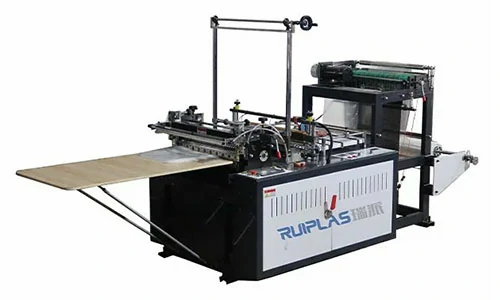
Cold cutting separates plastic bags without melting the edges, producing clean, precise cuts. Unlike hot cutting, which simultaneously seals and melts through the film, cold cutting is ideal for applications where edge quality matters. The machine produces bottom-sealed plastic bags—commonly used for shopping bags, merchandise bags, and flat-bottom pouches—with a sealed bottom and clean top edge.
Bottom sealing creates a strong, reliable seal at the base of each bag. This is essential for bags that need to hold weight—shopping bags, product packaging, and retail pouches. The sealing mechanism works in tandem with the cold cutting system to produce finished bags ready for use.
Cold cutting eliminates the edge curling and material distortion that can occur with hot cutting systems. The result is a professional-looking bag with crisp, straight edges—important for retail applications where appearance matters.
Production speed directly affects your ability to meet orders. The RP-FQ series offers bag making speeds from 30 to 130 pieces per minute, depending on the model. The speed range balances efficiency with precision, ensuring consistent quality at high output rates.
RP-FQ600 & RP-FQ800: 30-130 pcs/min
RP-FQ1000: 30-120 pcs/min
RP-FQ1200: 30-100 pcs/min
Maximum bag making width ranges from 550mm to 1150mm across the four models. Maximum bag making length is 1600mm for all models. This range accommodates everything from small merchandise pouches to large shopping bags.
The equipment supports multiple plastic raw materials, including PE, PP, and PVC, with customizable raw material options. This flexibility allows you to switch between different bag types without changing machines.
Whether you're producing biodegradable bags, heavy-duty shopping bags, or lightweight merchandise pouches, the machine adapts to your material requirements. The ability to quickly switch production specifications makes it ideal for small-batch customized production.
Different materials have different sealing and cutting characteristics. The machine's design accommodates these variations, ensuring consistent quality across PE, PP, and PVC substrates.
Energy consumption is a significant operational cost. The RP-FQ600 model operates with a main power of just 1.1KW, reducing operational costs. Higher-capacity models use proportionally more power: RP-FQ800 at 1.5KW, RP-FQ1000 at 2.2KW, and RP-FQ1200 at 3.0KW.
| Model | Main Power |
|---|---|
| RP-FQ600 | 1.1KW |
| RP-FQ800 | 1.5KW |
| RP-FQ1000 | 2.2KW |
| RP-FQ1200 | 3.0KW |
Lower power consumption translates directly to reduced electricity bills and lower per-bag production costs. This is particularly valuable for high-volume operations where energy costs represent a significant portion of operating expenses.
Downtime costs money. The RP-FQ series features a modular design that simplifies cleaning and upkeep, minimizing downtime. The modular approach means components can be accessed, cleaned, and replaced more efficiently than with integrated designs.
The modular design allows operators to access key components without disassembling large sections of the machine. This reduces maintenance time and keeps the machine running longer between service intervals.
The machine includes an accurate metering system that reduces raw material waste. This improves production efficiency and cost-effectiveness by ensuring consistent material usage across production runs.
Understanding the machine's physical footprint is essential for facility planning. The RP-FQ series models have the following dimensions and weights:
| Model | Weight | Overall Size (mm) |
|---|---|---|
| RP-FQ600 | 700KG | 2900×1300×1500 |
| RP-FQ800 | 800KG | 2900×1500×1600 |
| RP-FQ1000 | 900KG | 3200×1800×1700 |
| RP-FQ1200 | 1000KG | 3400×2000×1800 |
The largest model, RP-FQ1200, requires approximately 3.4 meters in length and 2 meters in width. Plan your production floor accordingly to accommodate the machine and allow space for operator access and material handling.
Machine weights range from 700KG to 1000KG. Ensure your floor can support the weight, particularly for the larger models. Consider vibration isolation if the machine will be installed on upper floors.
What's the difference between cold cutting and hot cutting?
Cold cutting separates bags without melting the edges, producing clean cuts without edge curling. Hot cutting simultaneously seals and melts through the film. Cold cutting is preferred when edge quality and appearance are important.
What materials can this machine process?
The machine supports PE, PP, and PVC, with customizable raw material options. This covers most common plastic bag applications.
What bag types can it produce?
The machine produces bottom-sealed plastic bags, commonly used for shopping bags, merchandise bags, and flat-bottom pouches.
How fast does it run?
Production speed ranges from 30 to 130 pieces per minute, depending on the model. The RP-FQ600 and RP-FQ800 run at 30-130 pcs/min, while the RP-FQ1200 runs at 30-100 pcs/min.
What's the maximum bag size?
Maximum bag making width ranges from 550mm to 1150mm. Maximum bag making length is 1600mm for all models.
How is maintenance handled?
The modular design simplifies cleaning and upkeep, minimizing downtime. The accurate metering system also reduces raw material waste.
Selecting a cold cutting bag making machine comes down to three factors: production speed (match your volume), bag size (match your market), and power efficiency (match your operating budget). Request a quote or machine consultation → —Ruipai's team can help you select the right RP-FQ model for your specific production requirements.
Ruipai is a manufacturer of plastic bag making machinery with extensive experience in the industry. The Cold Cutting Plastic Bag Making Machine (RP-FQ Series) is available in four models—RP-FQ600, RP-FQ800, RP-FQ1000, and RP-FQ1200—with maximum bag making widths from 550mm to 1150mm and a maximum bag making length of 1600mm. Production speeds range from 30 to 130 pieces per minute depending on the model. The machine supports PE, PP, and PVC materials, features a modular design for easy maintenance, and includes an accurate metering system to reduce raw material waste. Applications include shopping bags, merchandise bags, and flat-bottom pouches. Ruipai provides comprehensive technical support and responsive after-sales service. Connect with Ruipai to discuss your bag types, material requirements, and production volume needs.
Environmentally friendly materials
Integrated production lines
Maximising your return on investment
GET A QUOTE


 English
 Español