You’ve seen the brochures for three‑layer and five‑layer lines. They promise barrier properties, exotic structures, and high‑end performance. But here’s a question: do you actually need all that? A Film Blown Machine with mono layer extrusion uses one extruder to produce a single layer of plastic film. That‘s it. No multiple materials. No complex co‑extrusion die. Just one melt, one bubble, one roll. This guide covers what mono layer machines actually make—grocery bags, agricultural covers, produce bags, liners—and where they fall short. More importantly, we’ll look at the production numbers that help you decide whether mono layer is the right workhorse or whether you should be saving up for a multi‑layer line.
Mono layer excels at commodity products where cost per kilogram matters more than exotic barrier performance. It runs the workhorse materials—LDPE, HDPE, LLDPE—and increasingly, biodegradable resins like PLA and PBAT. Output thickness typically ranges from 0.008mm to 0.15mm, with folding widths from 100mm up to 5000mm depending on screw size and die configuration.
What mono layer doesn‘t do is multi‑layer structures. You won’t get an EVOH oxygen barrier. You won‘t get a sealable inner layer with a different material on the outside. For those applications, you need co‑extrusion.
The table below shows where mono layer fits best:
| Application Category | Mono Layer Suitability | Typical Material |
|---|---|---|
| T‑shirt bags (shopping) | Excellent | HDPE / LDPE |
| Garbage bags (thick, 20–100 µm) | Limited—ABA better for high strength | LDPE / LLDPE |
| Produce bags (thin, 6–18 µm) | Excellent | Virgin LDPE |
| Agricultural mulch film | Good | LDPE / LLDPE / EVA |
| Compostable bags (PLA/PBAT) | Very good | PLA / PBAT |
| Heavy‑duty shrink film | Poor—needs multi‑layer | LDPE / LLDPE blend |
| High‑barrier food packaging (EVOH) | Not suitable | — |
The screw diameter drives the output. Common sizes range from Ø45 mm to Ø90 mm for standard mono layer lines, with outputs from 30 kg/h to 180 kg/h. Larger screws (up to Ø110 mm or dual‑screw configurations) can push 280–450 kg/h for wide‑web agricultural or industrial film. LDPE delivers flexibility, clarity, and heat sealability—ideal for produce bags and general‑purpose packaging. LLDPE adds tensile strength and puncture resistance, often blended with LDPE for agricultural film. HDPE provides stiffness and tear resistance—the standard for T‑shirt bags. EVA is used in agricultural film for improved clarity and low‑temperature toughness. Biodegradable resins (PLA, PBAT) are increasingly common for compostable bags. The chart below gives realistic throughput expectations:
| Screw Diameter (mm) | Typical Output (kg/h) | Film Width Range (mm) | Thickness (mm) |
|---|---|---|---|
| Φ45 | 30–35 | 100–600 | 0.004–0.08 |
| Φ50–55 | 45–60 | 100–1100 | 0.004–0.10 |
| Φ60–65 | 60–80 | 100–1500 | 0.008–0.12 |
| Φ70–80 | 80–130 | 200–1800 | 0.008–0.15 |
| Φ85–90 | 130–180 | 200–2000 | 0.01–0.15 |
| Φ110 | 280+ | 200–2500 | 0.01–0.20 |
The math on mono layer is straightforward. Lower machine cost (one extruder instead of two or three). Lower energy consumption — a mono layer line uses roughly half the electricity of a comparable ABA line. Simpler operation means less training for operators; someone can learn the basics in days, not weeks.
But there‘s a trade‑off. Mono layer uses more virgin material because it can’t hide recycled content or calcium carbonate in a middle layer. In thicker films (20–100 microns), ABA co‑extrusion can cut raw material cost by 30–50% by loading the core with filler. Mono layer can‘t do that.
For produce bags under 18 microns made with virgin LDPE, mono layer remains the most cost‑effective option. For garbage bags above 20 microns, ABA lines have become the industrial standard in many markets. Many film producers run both: mono layer for thin, high‑clarity work; ABA for thicker, strength‑driven products.
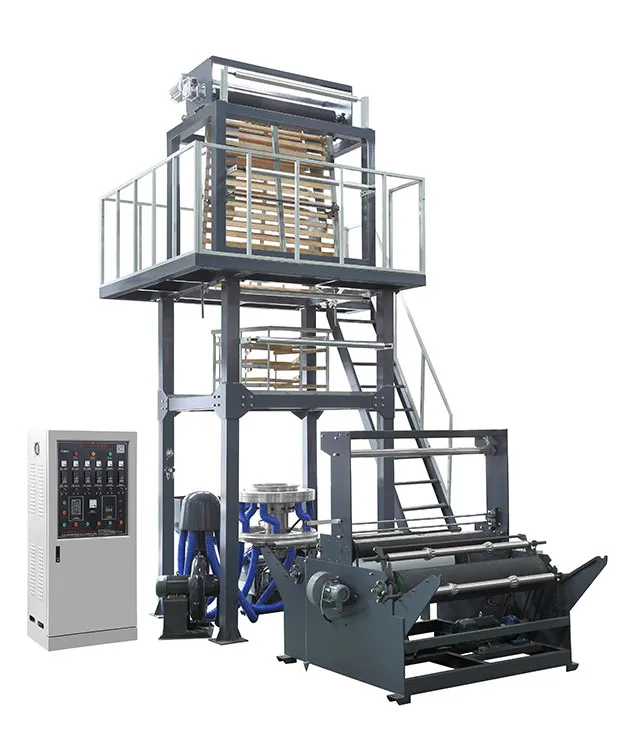
When you compare quotes, skip the glossy marketing and focus on these numbers instead. Screw L/D ratio — look for 30:1. Shorter 25:1 screws deliver poorer melt homogeneity and lower output. Modern mono layer lines use 30:1 or even 32:1 for better plastication, especially when running recycled content. Die type and size — the die diameter determines maximum folded film width. As a rule of thumb, max lay‑flat width is roughly 60–70% of die circumference. Too large a die for your target width wastes material and makes bubble control harder. Gravimetric dosing is essential for consistent layer distribution, especially when blending multiple resins or running regrind. Weight‑controlled feeders adjust screw speed automatically to maintain target output per hour. Extruder temperature control accuracy — look for ±1°C precision on barrel zones. Poor temperature control shows up as gels, unmelted particles, or gauge bands in the finished roll.
Walking through a typical grocery store, mono layer film is everywhere.
Produce bags. The thin, clear, perforated rolls in the vegetable section. Mono layer excels here because thickness is low (8–15 microns), clarity matters, and virgin material is acceptable. ABA would be overkill.
T‑shirt bags. Standard retail shopping bags made from HDPE. Mono layer lines running 55–65mm screws at 50–80 kg/h produce most of the world‘s T‑shirt bags. The economics are well proven.
Agricultural mulch film. Black LDPE/LLDPE film laid over crop rows. Mono layer lines up to 2,000mm width produce hundreds of thousands of tons annually. No barrier layers are needed—just consistent thickness and UV stability.
Compostable bags. PLA and PBAT process similarly to LDPE but with lower melt temperatures (150–170°C vs 180–220°C). Many mono layer lines now include dedicated temperature control profiles for bio‑resins.
If you plan to run calcium carbonate–filled resins or recycled content, the abrasive fillers will wear screw and barrel faster. Hardened bimetallic barrels and coated screws (tungsten carbide or chromium) extend life by 3–5 times. RUIPAI offers wear‑resistant packages specifically for mono layer lines running aggressive materials.
If any of these describe your operation, mono layer may not be the right answer. First, you run garbage bags over 20 microns thick. The material savings from adding CaCO₃ or recycled content to a core layer easily justify the higher machine cost. ABA lines running 65–75 mm screws pay back within 12–18 months on thick bags. Second, your market requires 30%+ recycled content. Mono layer can run regrind, but surface quality suffers because recycled material appears on the film surface. ABA hides recycled content in the core, keeping the outer layers smooth and printable. Third, you need differential properties (e.g., seal inside, print outside). Mono layer is one material, one property, one surface. ABA allows different formulations on each side.
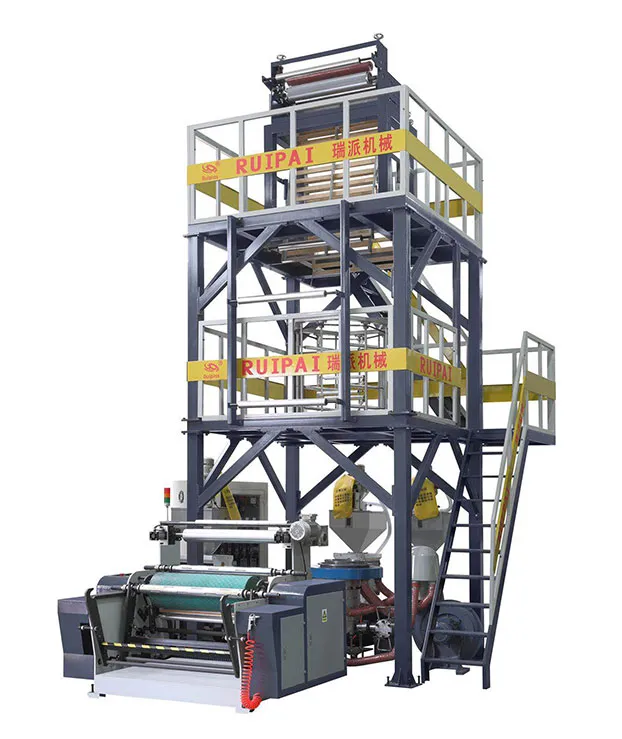
When mono layer is the right fit, having a reliable machine makes all the difference. RUIPAI‘s Film Blown Machine in mono layer configuration uses a high‑efficiency 30:1 screw, precision temperature control (±1°C), and a low‑friction die for consistent bubble stability. The line supports film thickness from 0.008mm to 0.15mm, widths up to 2000mm folded, and outputs from 30 kg/h to 180 kg/h depending on screw size.
What operators appreciate most is the simplified control system. The touchscreen interface stores up to 100 material recipes—call up your LDPE produce bag profile, and the extruder zones, die heaters, air ring settings, and winding tension adjust automatically. Changeover between products takes under 15 minutes.
RUIPAI includes a 12‑month warranty, on‑site installation supervision, and operator training. Spare parts for wear items (screws, barrels, dies) are stocked in regional warehouses with 48‑hour delivery to most markets.
Daily: wipe die lips, check air ring for blockages, verify bubble stability. Weekly: clean cooling fan filters, inspect screws and barrels for unusual wear (visible scoring on internal surfaces), check belt tensions. Monthly: recalibrate thermocouples, test emergency stops, rotate die gap adjustment screws.
Can a mono layer line run recycled content? Yes, up to 30% post‑industrial or well‑sorted post‑consumer regrind. Above that, melt filtration becomes critical, and surface quality may suffer. How much floor space does a mono layer line need? About 8–12 meters in length including unwind, extruder tower, bubble cooling, collapsing frame, and winder. Add 2 meters for service access. What’s the power draw? A 65mm mono layer extruder with IBC and winder typically draws 40–60 kW at full load. How long before I need to replace the screw? With standard LDPE, 8–10 years. With 30% CaCO₃ filler, expect 3–5 years unless you upgrade to a wear‑resistant coating.
Mono layer isn‘t glamorous. It won’t win awards for innovative structures. But for a huge slice of the film market—bags, liners, agricultural covers, produce wrap—it remains the most cost‑effective, simplest-to-run solution.
Calculate your annual material consumption. If you run under 300 tons per year of thin film (<25 microns), mono layer will likely be your lowest total cost. If you run over 500 tons of thick film (>25 microns), run the numbers on ABA — the material savings often justify the upgrade. But for everything else, the single‑layer workhorse keeps running, shift after shift.
【Request a quote from RUIPAI for the Mono layer film blowing machine】 — Share your target daily output (kg/h or tons/day), film width, thickness range, and primary resin (LDPE, LLDPE, HDPE, or biodegradable). Their technical team will recommend screw diameter, die size, and optional features like IBC or gravimetric dosing.
Environmentally friendly materials
Integrated production lines
Maximising your return on investment
GET A QUOTE


 English
 Español