For roll-to-roll processors of films, paper, aluminum foil, and flexible packaging, material waste directly erodes profit margins and delays order fulfillment. Slitting machines equipped with servo control, intelligent tension management, and precision cutting systems can drastically reduce typical industrial waste rates from 8% to 12% to 1.5% to 3%. This is no small amount: for a factory processing 500 tons of high-quality substrate per month, a mere 5% reduction in waste can save over $120,000 in raw material costs annually.
Manual and semi-automatic settings cause avoidable losses due to the following four long-standing defects:
* Excessive dimensional tolerances (±0.8–1.5mm), forcing over-trimming to meet specifications
* Unstable roll tension, leading to wrinkling, roll stretching, and off-cutting
* Frequent manual cutter adjustments result in edge burrs and unusable scrap
* Inefficient dimensional arrangement leads to significant leftover material after job changes
Modern high-speed servo slitting systems employ closed-loop control, locking width accuracy to ±0.05mm without the need for safety margins, thus avoiding waste. Automatic tension balancing maintains consistent roll pressure during unwinding, slitting, and rewinding, preventing material deformation and edge damage.
Integrated waste removal and recycling functions collect scrap in real time, while one-click size presets reduce changeover time by 80% and decrease startup waste from 15-20 meters per machine to less than 2 meters. These improvements enabled material utilization exceeding 97% in continuous production processes.
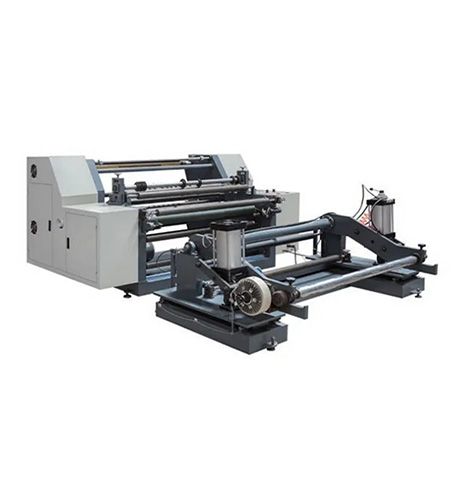
We tested two configurations using 20μm PET film (standard packaging substrate) for 8-hour cycles:
Semi-automatic slitting machine: Speed 100–130 m/min, scrap rate 7.8%, 2 operators, frequent downtime
Basic fully automatic slitting machine: Speed 180–220 m/min, scrap rate 4.2%, inconsistent rewinding quality
These data demonstrate that automation not only increases production speed but also transforms waste into marketable products. For medium to large-sized processors, the typical payback period is 12–18 months.
RUIPAI has designed multi-material adaptive slitting solutions for paper, PE film, aluminum foil, and composite substrates, offering customizable blade types (round, razor, shear) and tension profiles. For small-batch custom orders, a quick-change mandrel system minimizes scrap loss, while batch layout software optimizes the width layout across multiple orders, reducing leftover rolls.
When scaling up production, dedicated slitting machines designed for high-volume roll processing consistently reduce waste—something retrofitted equipment cannot match. Retrofitted cutting machines lack synchronized servo control, leading to uneven cutting and increased waste; basic cutting machines sacrifice precision to reduce upfront costs, ultimately resulting in long-term material loss.
Reducing roll waste requires more than just speed; it requires precision, automation, and material-specific engineering. A suitable automated slitting solution can transform every meter of substrate into usable product, thereby improving profit margins and competitive advantage.R
uipai focuses on providing low-waste industrial slitting equipment for the flexible packaging, printing, and nonwoven fabric processing industries, and offers comprehensive after-sales support and on-site commissioning services.
Environmentally friendly materials
Integrated production lines
Maximising your return on investment
GET A QUOTE


 English
 Español