A flat roll of BOPP or OPP film feeds into the machine. The unwinding station pulls the film through a series of rollers, correcting any lateral wandering with an automatic edge guide. The film folds over to form the bag shape. At the sealing station, heated knives descend, melting the polyethylene coating to seal the two side edges and the bottom edge in a single motion. The same knives cut the film between pouches. The finished bag drops onto a conveyor or stacker, counted automatically. This cycle repeats up to 140 times per minute. At that speed, the machine produces roughly 8,400 bags per hour — enough to fill a pallet of sock pouches before lunch.
That sequence describes a bag making machine configured for side sealing, also called a three‑side seal bag machine. The Ruipai side sealing bag making machine from Plast Machinery is designed for heat sealing and hot cutting of BOPP, OPP, and PE film, producing bags for socks, towels, bread, and garment covers. It features computer‑controlled length fixing, photocell tracking for printed registration marks, automatic gluing, and automatic punching.
A side seal bag is sealed on three edges — the bottom and two sides — leaving the top edge open for filling. Unlike a bottom seal bag where the seal runs only across the bottom, the side seal configuration creates a pouch with a straight, uniform opening. This shape is ideal for products that slide in easily, such as socks, bread loaves, or folded towels. This article explains how the machine pulls off this triple seal in one pass, why the heating knife temperature is adjustable from 0‑300°C, and where the 990mm maximum bag width fits in a flexible packaging line that runs both small merchandise bags and large garment covers.
A bottom seal bag making machine seals only the bottom edge of the bag. The sides are formed by folding the film, not by sealing. This leaves a potential leak path if the fold is not perfect. A side seal machine seals both side edges and the bottom edge in a single operation. The result is a pouch with three fully welded edges. For products that must be kept dust‑free or moisture‑free — such as bread or medical textiles — the side seal provides a more consistent barrier.
The Ruipai side sealing bag making machine uses a heated welding knife with temperature adjustable from 0‑300°C, controllable on the touch screen. For thin 0.01mm PE film, the operator sets a lower temperature to prevent burn‑through. For thick 0.10mm laminated BOPP, the temperature is increased to ensure complete melting of the sealing layer. The knife remains hot during the entire operation, so there is no warm‑up delay between bag cycles.
The machine is available in three sizes: RQL‑600, RQL‑800, and RQL‑1000. The maximum bag sealing width is 990mm for all models, but the maximum bag length increases with the model: 550mm for the 600, 750mm for the 800, and 950mm for the 1000. A 550mm bag length fits a standard sock pouch. A 950mm bag length accommodates a full‑size garment bag for a suit.
| Model | Max Bag Sealing Length | Max Bag Sealing Width | Bag Thickness | Speed |
|---|---|---|---|---|
| RQL‑600 | 550mm | 990mm | 0.01‑0.10mm | 140 pcs/min |
| RQL‑800 | 750mm | 990mm | 0.01‑0.10mm | 40‑140 pcs/min |
| RQL‑1000 | 950mm | 990mm | 0.01‑0.10mm | 40‑140 pcs/min |
Data sourced from Ruipai side sealing bag making machine specifications.
A bag making machine that seals three edges in one stroke is faster than a machine that seals the bottom only, because the side seal machine completes all edges in a single platen closure. The three‑side seal also means the bag stands open on the filling line, reducing the time a packer spends opening each pouch.
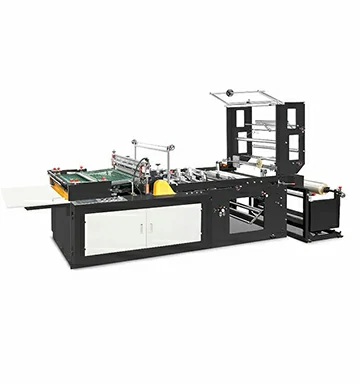
Printed film has registration marks — small dark squares printed on the edge. These marks tell the cutting knife where the boundary between bags lies. If the film stretches or the printing cylinder slips, the registration mark shifts. A bag making machine (主词加粗第3次) without tracking will cut through the middle of the brand logo.
The Ruipai side sealing machine is equipped with a photocell tracking system that reads the registration marks in real time. When the mark arrives earlier or later than expected, the PLC calculates the error and adjusts the bag pull length for the next cycle, shifting the cut position back into register. If the sensor fails to detect a mark — because a film splice passes through or the ink density varies — the machine triggers an alarm and stops immediately. For a line running 140 bags per minute, stopping within 1‑2 cycles saves up to 280 bags of material per lost‑mark event.
The photocell also enables the machine to produce bags with printed designs. A sock bag with a brand logo must have the logo centered on the bag, not cut off at the edge. The photocell ensures the cut lands exactly in the printed gap between logos. The system also supports automatic gluing for bags that require a resealable adhesive strip and automatic punching for hanger holes or hang tabs, all synchronized by the same registration signal.
The RQL‑600 runs at a fixed 140 bags per minute regardless of bag size. The RQL‑800 and RQL‑1000 run at 40‑140 bags per minute, with the speed varying by bag length. A 200mm bag runs faster because the film travels less distance between cuts. A 950mm bag runs slower because the film must advance nearly a meter before the next cycle.
At 140 bags per minute, a 200mm bag yields 16,800 running meters per hour. At 140 bags per minute and 200mm per bag, the machine outputs 28 metres of finished bags per minute — enough to fill a 600mm diameter roll of garment bags in under 20 minutes. The main motor power ranges from 1.1kW to 2.2kW, depending on the model.
The speed rating assumes the film is within the specified thickness range of 0.01‑0.10mm. Running 0.10mm film at 140 bags per minute requires more heating power than running 0.01mm film because the thicker material takes longer to melt. The temperature controller is separate from the speed controller; the operator sets the welding knife temperature based on the film thickness, and the machine automatically adjusts the dwell time to maintain seal quality at speed.
A bag making machine that runs 140 bags per minute with a 990mm bag width is suitable for high‑volume converters. A garment bag plant producing 50,000 bags per shift runs the RQL‑1000 for about six hours. The remaining two hours are for setup, film roll changes, and quality checks.
The side sealing bag making machine is listed for bags for socks, towels, bread, garment covers, and similar products. Each application places different demands on the machine.
Sock pouches: Small bags (100‑200mm wide, 200‑300mm long) run at the highest speed — 140 bags per minute. The photocell tracking ensures the brand logo is centered. Automatic punching creates a Euro‑slot for rack display. The bag is typically made from clear OPP film so the product is visible.
Bread bags: The machine produces bags from food‑grade LDPE or LLDPE. The sealing temperature must be controlled precisely; overheating can cause the film to stick to the knife, leaving a rough edge. The side seal configuration is preferred over bottom seal because the bag stands open for filling on a bread line. The 550‑950mm bag length range covers small dinner rolls to large artisan loaves.
Towels and linen packaging: The machine produces side seal bags from 0.03‑0.05mm PE film. The bag must be dust‑tight to keep linens clean in warehouse storage. The three‑side seal provides a better barrier than a bottom seal bag. The automatic gluing function applies a resealable adhesive strip for bags designed to be opened and reclosed.
Garment covers: The RQL‑1000 with 950mm bag length and 990mm width fits a full‑size suit or dress. The bag is typically made from clear 0.02‑0.03mm PE or OPP film. The machine includes automatic punching for hanger holes. The photocell tracking ensures the hanger hole is positioned consistently from bag to bag.
Ruipai (Zhejiang Ruipai Plastic Machinery Co., Ltd.) has manufactured bag making equipment for over a decade. The side sealing bag making machine is a dedicated three‑side seal unit for BOPP, OPP, and PE film, producing bags up to 990mm wide and 950mm long. The machine features a computer‑controlled length fixing system, photocell tracking with auto‑stop, automatic gluing and automatic punching, a heated welding knife with 0‑300°C adjustable temperature, and a touch screen interface for storing bag length and temperature settings. The machine is CE certified and backed by an 18‑month warranty.
A bag making machine that seals three edges in one pass, tracks printed registration marks without operator intervention, and punches hang holes while running at 140 bags per minute keeps a packaging line flowing without constant supervision. For a converter who produces sock pouches in the morning and garment bags after lunch, the Ruipai side sealing bag making machine delivers the width range, speed flexibility, and registration accuracy that multi‑product lines require.
【Request a quote from Ruipai】
Contact Ruipai with your target bag size (width up to 990mm, length 200‑950mm), film type (BOPP, OPP, PE), and daily output requirement to receive a side sealing bag making machine configuration recommendation and a sample production video.
Environmentally friendly materials
Integrated production lines
Maximising your return on investment
GET A QUOTE


 English
 Español